In the contemporary digital landscape, search engine marketing in digital marketing serves as the primary bridge between a brand's value proposition and the active intent of the consumer. Unlike passive advertising, this strategic approach leverages the exact moment a user seeks a solution, ensuring that businesses aren't just seen, but are found by the right audience at the optimal time.
The global shift toward "search-first" consumer behavior has transformed how organizations acquire customers, moving from broad-spectrum broadcasting to precision-targeted acquisition. By integrating paid search (PPC) with organic optimization, companies can dominate the Search Engine Results Pages (SERPs), effectively reducing the cost of customer acquisition while increasing the lifetime value of the leads generated.
Understanding the nuances of search engine marketing in digital marketing is no longer an optional luxury for businesses; it is a foundational requirement for survival in a saturated market. Whether for a local service provider or a global enterprise, the ability to manipulate visibility through algorithmic alignment determines who captures the market share and who remains invisible in the depths of the second page.
Global Relevance of Search Engine Marketing
On a global scale, the reliance on search engines has created a standardized gateway to information. According to industry benchmarks and data echoing digital transformation trends seen in World Bank reports, the digitalization of commerce in emerging markets has accelerated the need for search engine marketing in digital marketing to facilitate trade and service discovery.
The primary challenge today is "digital noise." With millions of websites competing for a few pixels of screen real estate, the gap between a high-authority site and a dormant one is widening. SEM provides the surgical precision required to bypass this noise, allowing brands to align their offerings with specific user intent signals in real-time.
Defining the Mechanics of SEM
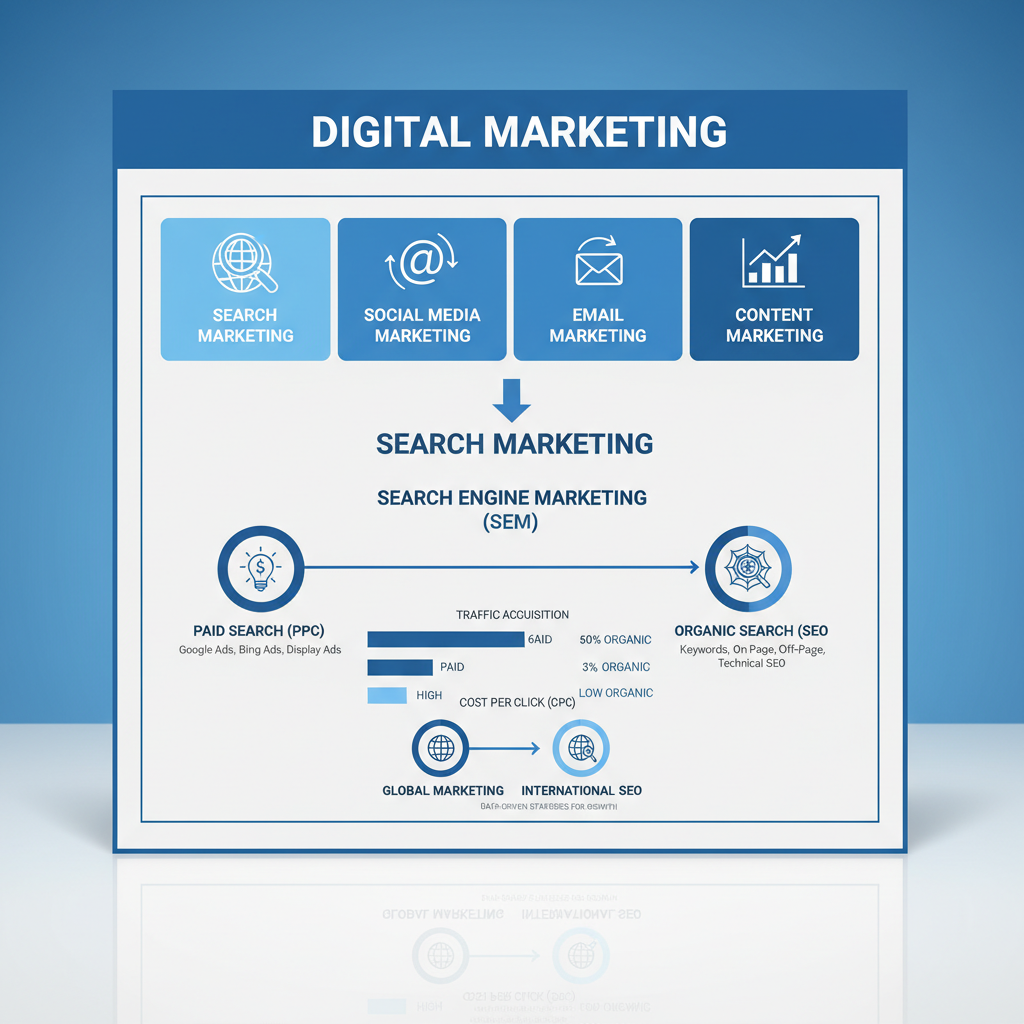
At its simplest, search engine marketing in digital marketing is the process of increasing a website's visibility in the search engine results pages through a combination of paid advertising and organic optimization. While often used interchangeably with SEO, SEM is the broader umbrella that encompasses both the "earned" traffic of organic search and the "bought" traffic of paid campaigns.
In the context of modern industry, this is akin to digital real estate management. Just as a physical store requires a prime location to attract foot traffic, a digital business requires a prime "search location" to attract clicks. The synergy between paid ads for immediate traction and SEO for sustainable growth creates a balanced acquisition funnel.
This connection is vital for humanitarian and niche industry needs as well. For instance, during global health crises or economic shifts, SEM allows critical information and essential services to surface instantly, ensuring that those in need find legitimate providers without having to sift through outdated directories.
Core Components for High Visibility
The first pillar of search engine marketing in digital marketing is Keyword Intelligence. This involves not just finding high-volume terms, but understanding the "search intent"—whether the user is looking for information, comparing options, or ready to make a purchase.
Secondly, Quality Score and Ad Relevance play a critical role. Search engines reward advertisers who provide a seamless transition from the search query to the landing page. A high-quality score reduces the cost-per-click (CPC) and improves the ad's positioning, making the marketing spend far more efficient.
Finally, technical scalability and UX optimization ensure that the traffic generated by search engine marketing in digital marketing actually converts. Fast load times, mobile responsiveness, and clear calls-to-action transform a simple visitor into a loyal customer, closing the loop on the marketing investment.
Practical Applications Across Industries
The application of search engine marketing in digital marketing varies wildly by sector. In the B2B professional services realm, SEM is used to capture high-intent "bottom of the funnel" leads, where users search for specific solutions like "enterprise cloud security audit" or "corporate tax consultancy."
In contrast, e-commerce brands utilize a mix of Shopping Ads and dynamic search ads to showcase products visually. For example, in remote industrial zones, companies providing specialized machinery parts use hyper-local SEM to target procurement managers who need urgent replacements, ensuring the solution is found in seconds.
Effectiveness of Different SEM Strategies in Digital Marketing
Tangible Benefits and Long-Term Value
The most immediate benefit of search engine marketing in digital marketing is the ability to generate instant traffic. Unlike organic growth, which can take months to materialize, a well-structured PPC campaign can put a brand in front of thousands of qualified users within hours, providing an immediate feedback loop for product-market fit.
Beyond the numbers, there is an emotional component of trust. Users inherently trust the top results of a search engine. By maintaining a consistent presence through both paid and organic means, a brand builds an image of authority and reliability, which is essential for high-ticket B2B services where trust is the primary currency.
Emerging Trends in Search Algorithms
The future of search engine marketing in digital marketing is being rewritten by Artificial Intelligence and Generative Search Experiences (SGE). We are moving from a "keyword-based" search to an "entity-based" search, where the algorithm understands the context and relationship between concepts rather than just matching words.
Voice search and visual search are also redefining how we approach SEM. As users shift toward "Hey Siri" or "Google Lens," the focus is shifting toward long-tail, conversational phrases and high-quality imagery. This requires a more holistic content strategy that prioritizes natural language processing (NLP).
Sustainability and "Green SEO" are also emerging as priorities. Search engines are beginning to favor websites that demonstrate a commitment to digital sustainability—meaning leaner code, faster load times, and a lower carbon footprint for data hosting—aligning business growth with global environmental goals.
Overcoming Common Implementation Challenges
One of the most frequent pitfalls in search engine marketing in digital marketing is the "budget leak"—spending heavily on broad keywords that bring traffic but no conversions. The solution lies in negative keyword lists and strict match-type management to ensure that every cent spent is directed toward high-intent users.
Another challenge is the silos between SEO and PPC teams. When these two functions operate independently, they often bid against each other or miss opportunities to share data. An integrated approach allows the PPC team to identify high-converting keywords that the SEO team can then target for long-term organic ranking.
Finally, the volatility of algorithm updates can be daunting. The only sustainable solution is to focus on the E-E-A-T principles (Experience, Expertise, Authoritativeness, and Trustworthiness). By creating truly helpful, human-centric content, a brand can weather any update, as search engines will always prioritize the best answer for the user.
Comparative Analysis of SEM Strategy Dimensions
| Strategy Dimension |
Implementation Cost |
Time to Result |
Sustainability Score |
| Hyper-Targeted PPC |
High (Variable) |
Instant |
4/10 |
| Long-Tail SEO |
Low to Medium |
Slow (3-6 Months) |
9/10 |
| Local Map Pack |
Low |
Medium |
7/10 |
| Content Authority Hubs |
Medium to High |
Slow |
10/10 |
| Dynamic Search Ads |
Medium |
Fast |
5/10 |
| Remarketing Lists (RLSA) |
Medium |
Fast |
6/10 |
FAQS
SEO (Search Engine Optimization) focuses exclusively on earning organic traffic by improving site quality and relevance. SEM (Search Engine Marketing) is a broader term that includes SEO but adds paid strategies like PPC. In short, SEM is the holistic approach to visibility, while SEO is the organic component of that visibility.
Paid SEM campaigns can yield results instantly; as soon as your ad is live and your bid is competitive, you will see traffic. Organic SEO, however, is a long-term play, typically taking 3 to 6 months to show significant ranking improvements depending on the competitiveness of the keyword.
Yes, because SEM allows for extreme precision. Instead of broad advertising, small businesses can bid on "long-tail keywords" (specific 3-5 word phrases) that have lower competition and higher conversion rates, ensuring that the budget is spent only on users with high intent.
Not necessarily. Google uses a combination of "Bid" and "Quality Score." If your ad is irrelevant or your landing page provides a poor user experience, Google will not show your ad regardless of your budget, or it will charge you significantly more per click than your competitors.
AI is moving search from "links" to "answers." With the rise of SGE, users get synthesized answers directly on the search page. This means SEM will shift toward optimizing for "mention" and "citation" within AI-generated summaries, requiring higher-quality, authoritative content.
Yes, tools like Google Ads and various SEO plugins make it accessible. However, the complexity of keyword research and algorithmic updates means that many businesses eventually move to a professional service to avoid wasteful spending and ensure compliance with evolving SEO guidelines.
Conclusion
Integrating search engine marketing in digital marketing is the most effective way to align business objectives with consumer intent. By balancing the immediate impact of paid search with the enduring authority of organic optimization, companies can build a resilient acquisition engine that scales alongside their growth. The core of success lies in the synergy of technical precision, user-centric content, and a deep understanding of algorithmic evolution.
As we move toward an AI-driven search future, the emphasis will shift even further toward trust and expertise. Businesses that prioritize the user experience today will be the ones that dominate the search landscapes of tomorrow. To start optimizing your digital presence and capturing high-intent traffic, visit our website: www.ecglobaladvisor.com.